
“Doubt: A Parable” by John Patrick Shanley is one of the most powerful and provocative plays of the 21st century. Winner of both the Pulitzer Prize for Drama and the Tony Award for Best Play in 2005, this gripping drama explores moral certainty, institutional power, and the nature of truth – all within the walls of a Bronx Catholic school in 1964.
“Doubt requires more courage than conviction does, and more energy; because conviction is a resting place and doubt is infinite.”
– John Patrick Shanley, preface to Doubt: A Parable
At a Glance
| Detail | Information |
|---|---|
| Playwright | John Patrick Shanley (born 1950, The Bronx, New York) |
| Premiere | November 23, 2004 – Manhattan Theatre Club (Off-Broadway) |
| Broadway transfer | March 2005 – Walter Kerr Theatre; closed July 2, 2006 |
| Setting | St. Nicholas Church School, the Bronx, 1964 |
| Running time | Approximately 90 minutes, no intermission |
| Cast size | 4 (2 women, 2 men) |
| Awards | 2005 Pulitzer Prize for Drama, 4 Tony Awards including Best Play |
| Film adaptation | 2008, directed by Shanley – Meryl Streep, Philip Seymour Hoffman, Amy Adams, Viola Davis |
Plot Summary
Father Flynn opens with a sermon on doubt, suggesting uncertainty can unite people. Meanwhile, Sister Aloysius – the school’s rigid principal – grows suspicious of Flynn’s interactions with Donald Muller, the school’s first Black student. She enlists the idealistic young Sister James, who has noticed unusual behaviour.
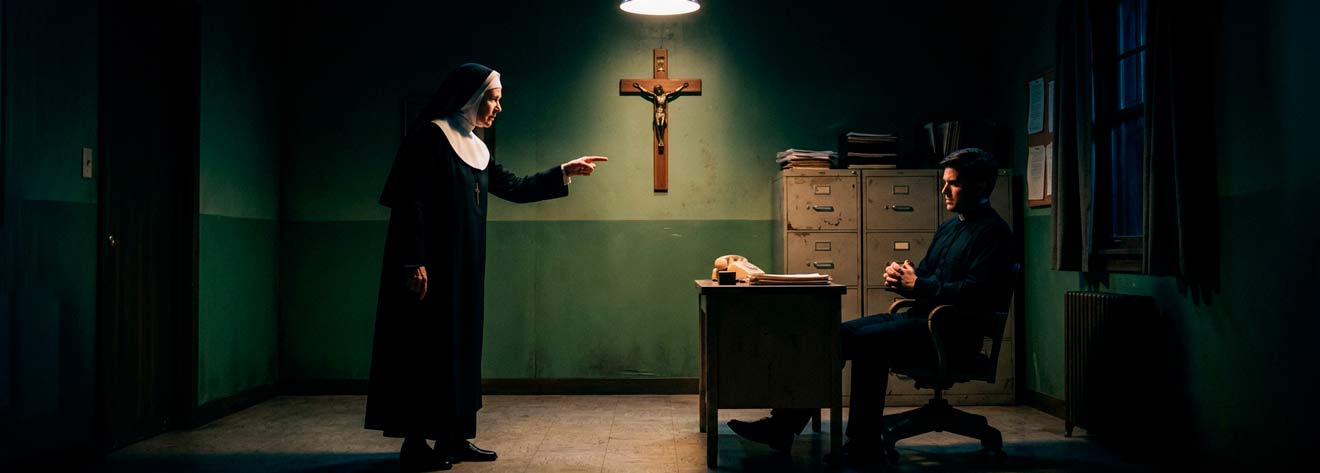
Sister Aloysius confronts Father Flynn directly. He offers explanations, but she remains unconvinced. She meets with Donald’s mother, Mrs. Muller, hoping for an ally – but Mrs. Muller’s response is far more pragmatic and complex than expected. In a final confrontation, Sister Aloysius claims to have called Flynn’s previous parish – but the audience never learns if this is true.
Flynn is transferred to another parish with a promotion. Sister Aloysius, seemingly victorious, breaks down with the play’s devastating final words.
Fun Fact: Shanley named the character of Sister James after a real nun who taught him at St. Anthony’s Grammar School in the Bronx. He has described the play as inspired by ‘courtroom culture’ in America, the Iraq War, and the Catholic abuse crisis.
Character Breakdown
| Character | Age | Key Traits | Original Broadway Cast | 2008 Film Cast |
|---|---|---|---|---|
| Sister Aloysius Beauvier | 50s-60s | Traditional, unwavering, suspicious, ruthless in pursuit of justice | Cherry Jones (Tony Award) | Meryl Streep (Oscar nom.) |
| Father Brendan Flynn | Late 30s | Progressive, charismatic, working-class, from the Northeast | Brían F. O’Byrne (Tony Award) | Philip Seymour Hoffman (Oscar nom.) |
| Sister James | 20s | Idealistic, conflicted, kind-hearted, caught between two forces | Heather Goldenhersh | Amy Adams (Oscar nom.) |
| Mrs. Muller | ~38 | Pragmatic, protective, devastatingly honest about her son’s situation | Adriane Lenox (Tony Award) | Viola Davis (Oscar nom.) |
Fun Fact: All four leads in the 2008 film received Oscar nominations – making Doubt one of only a handful of films in history where every principal actor was nominated.
Historical Context
To understand the world of Doubt, you need to look at two historical forces: the upheaval within the Catholic Church during the 1960s and the real‑life scandals that broke in Boston decades later.
Vatican II and the 1960s
The play is set in 1964, during the sweeping reforms of the Second Vatican Council (Vatican II). The “New Mass” moved services from Latin to English, upending centuries of tradition. This created real tension between traditionalists (like Sister Aloysius) and progressive clergy (like Father Flynn). President Kennedy’s assassination in 1963 had shaken the Catholic community just a year earlier.
The Boston Globe Investigation
Shanley wrote the play in 2004, during the fallout from the Boston Globe’s Spotlight investigation into clergy abuse. Reporter Walter Robinson and his team revealed systemic cover-ups in the Boston archdiocese. Their work won the Pulitzer Prize and was later dramatized in the Oscar-winning film “Spotlight” (2015). A relative of Shanley’s was among the accusers in the John Geoghan case that triggered the investigation.
“What do you do when you’re not sure?”
– Father Flynn, opening sermon in Doubt: A Parable
Why Community Theatres Choose This Play
The reasons are both artistic and practical. Doubt offers powerful material for actors and audiences – and it is surprisingly easy to produce.
Practical Benefits
- Cast of only 4 – dramatically reduces production costs and scheduling complexity
- Minimal set requirements – office, garden, and church suggested with simple staging
- 90-minute runtime with no intermission – efficient for audiences and venues
- Extraordinary acting showcase – every role is demanding and rewarding
- Post-show discussion magnet – audiences debate the ending for hours
Community Theatre in Winnipeg
Winnipeg’s theatre scene – both professional and community – has long embraced challenging works. The Winnipeg Mennonite Theatre, which operated for over 50 years, demonstrated that community companies can tackle serious material with artistic integrity. Today, companies like Prairie Theatre Exchange, Theatre Projects Manitoba, Dry Cold Productions, and The Dramatic Theatre Company continue this tradition across Manitoba.
The Association of Community Theatres of Manitoba (ACT Manitoba) supports local productions with resources, festivals, and networking. Performance rights for “Doubt” are available through Dramatists Play Service.
Themes for Discussion
| Theme | Key Question |
|---|---|
| Certainty vs. doubt | Is Sister Aloysius justified in acting without proof? |
| Institutional power | How does gender and hierarchy shape who is believed? |
| The cost of justice | Can deception be ethical if it serves a righteous cause? |
| Tradition vs. change | Does Vatican II represent progress or loss? |
| Race and vulnerability | How does Donald’s identity affect every character’s choices? |
| Knowledge and belief | Can we ever truly know what happened between two people? |
“In the final analysis, I think the play is about the courage that it takes to maintain one’s moral convictions in the face of a power structure.”
– Doug Hughes, original director of Doubt